Introduction:
Road accidents continue to wreak havoc worldwide, causing significant loss of life, hospitalization, and economic burdens. With approximately 1.20 million lives lost annually, according to the World Health Organization (WHO), and the economic cost accounting for 3% of a country’s GDP, it is imperative to develop efficient accident detection systems that provide immediate medical assistance. In this blog post, we will explore the potential of vision-based accident detection systems and discuss the challenges they face.
Literature Review:
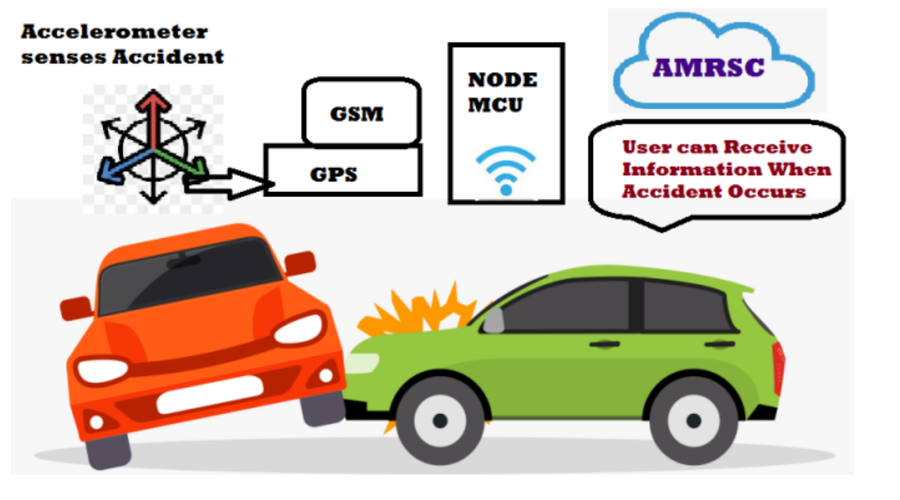
Accident detection systems can be broadly classified into two categories: IoT-based methods and vision-based methods. IoT-based systems employ sensors and hardware equipment in vehicles to monitor and detect accidents, triggering alerts to the relevant authorities. On the other hand, vision-based methods harness the power of computer vision and deep learning algorithms to analyze digital data, such as images and videos captured by traffic security cameras, for accident detection.
Numerous research papers have delved into vision-based accident detection and alert systems, utilizing techniques like deep learning, convolutional neural networks (CNNs), and feature fusion. For instance, Pillai et al. proposed a real-time accident detection system that employs a computationally efficient technique and a mini-YOLO object detection framework. Robles et al. introduced a CNN and recurrent layer architecture achieving an impressive accuracy of 98% for detecting vehicle collisions. Lu et al. developed a feature fusion-based framework, striking a balance between accuracy and detection speed with an accuracy of 87.78% and a detection speed exceeding 30 frames per second (FPS). These studies highlight the immense potential of vision-based methods in traffic accident detection.
Research Gap:
Despite significant progress, vision-based accident detection systems encounter several challenges. Adverse weather conditions, such as rain and thunderstorms, can hinder detection accuracy due to poor and noisy visual data. Complex and ambiguous crash scenes pose difficulties in accurate detection and low-detail feature extraction from training data. Furthermore, existing systems have limitations in detecting various types of accidents and expanding the number of vehicle classes beyond cars. High traffic density further compromises the accuracy of accident detection, necessitating the incorporation of motion models and sequence processing into the algorithms to improve accident classification.
Research Objectives:
To bridge the gaps in vision-based accident detection systems, the following research objectives have been identified:
-
Provide a comprehensive vehicle accident dataset with rich visual features to facilitate robust training and evaluation of detection algorithms.
-
Enhance the accuracy of accident detection in adverse climatic conditions, ensuring reliable performance even in challenging weather scenarios.
-
Improve detection accuracy for complex and ambiguous crash scenes, enabling precise identification of accidents in diverse environments.
-
Classify different types of accidents along with detection, including crashes, turn-overs, fires, and more, enabling prompt and appropriate response from authorities.
-
Expand the detection capabilities to include various vehicle classes such as motorbikes, trucks, and other common road vehicles, widening the scope of accident prevention and mitigation efforts.
Conclusion:
Vision-based accident detection systems hold tremendous promise in mitigating the devastating impact of road accidents. By harnessing the potential of computer vision and deep learning techniques, these systems can accurately detect accidents and provide timely alerts to the relevant authorities, enabling swift medical assistance and reducing response times. However, further research is imperative to address challenges associated with adverse weather conditions, complex scenes, and the classification of different accident types. With continued advancements in technology and dedicated research efforts, vision-based accident detection systems have the potential to significantly minimize the human and economic toll of road accidents, making our roads safer for all.